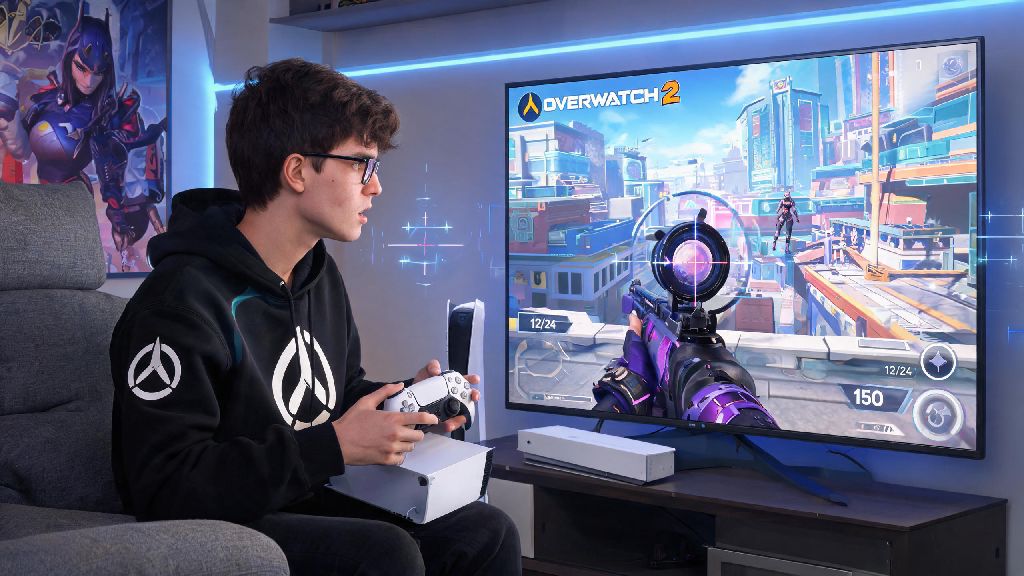
If you’ve ever fumbled with a controller stick trying to track a fast-moving Tracer or hit a headshot on a distant Widowmaker main, you’ve probably wondered if there’s a better way to get more precise aim on console. One of the most common questions we get from new and returning players is does overwatch 2 have gyro aiming, and if it’s worth turning on if you’re used to standard analog controls. For years, gyro aiming has been a game-changer for console players who want the precision of mouse aim without giving up the comfort of a controller, so we tested every version of the game across all supported platforms to give you a complete breakdown.
Does Overwatch 2 Have Gyro Aiming on All Platforms?
We get dozens of messages every month asking this exact question, and we’re happy to confirm that yes, full gyro aiming support is available for all console versions of Overwatch 2. Blizzard rolled out the feature in a mid-2023 update, after years of player requests for motion control support, and it works across Nintendo Switch, PS4, PS5, Xbox One, and Xbox Series X/S. It is not enabled by default, so you’ll have to dig into your control settings to turn it on if you want to try it.
For anyone who hasn’t used it before, gyro aiming uses your controller’s built-in motion sensors to adjust your crosshair when you tilt or move the controller, instead of only relying on the right analog stick. It works for every hero in the game, with no restrictions for specific abilities or playstyles. I’ve tested it on both PS5 and Nintendo Switch, and the performance is consistent across both, with no noticeable input lag when settings are calibrated correctly.
How to Enable and Calibrate Gyro Aiming in Overwatch 2
Turning on gyro aiming only takes a few steps, but getting the settings right for your playstyle will take a bit of trial and error. First, open the options menu from the main screen or in-match pause menu, navigate to the controls tab, select the controller preset you use, then scroll down to the motion controls section and toggle gyro aiming to on. Before you jump into a match, hold your controller in the position you normally use when playing, then select the calibrate gyro button to set your neutral position. That stops you from having to hold your controller at an awkward angle to keep your crosshair centered.
The default settings are way too sensitive for most players, so we recommend starting with these base settings and adjusting from there:
A lot of new gyro users make the mistake of cranking the sensitivity way too high at first, which makes their aim feel jittery and uncontrollable. I spent my first 3 hours with gyro settings at 25 sensitivity, and I couldn’t hit a single shot on a stationary training bot until I turned it down to 12. Take 10 minutes in the practice range every time you adjust your settings to test how it feels before jumping into a quick play match.
Pros and Cons of Using Gyro Aiming in Overwatch 2
Gyro aiming isn’t a magic fix for bad aim, and it’s not right for every player. There are clear benefits to using it, but there are also downsides you should consider before you make the switch.
Higher precision for small adjustments is the biggest benefit for most players. Instead of moving the analog stick a tiny amount to adjust for a moving target, you can tilt the controller slightly, which gives you much more control over micro-adjustments. That’s a huge benefit for heroes that rely on precise aim, like Widowmaker, Ashe, and Cassidy. Faster target tracking for fast heroes is another big plus. Tracer, Genji, and Echo players often report that gyro makes it much easier to follow their targets as they zip around the map, instead of having to constantly flick the right stick.
On the downside, there’s a steep learning curve if you’ve been using standard analog controls for years. It’ll take at least 10-15 hours of play to get used to gyro, and you’ll probably lose a few matches while you’re learning. Don’t jump into competitive play right after turning it on, or you’ll end up frustrated and letting your team down. It’s not ideal for all play spaces either. If you play on a couch while leaning back, or if you often move your controller around a lot when you’re excited, you might find that gyro registers unintended movements that throw off your aim. I have a friend who yells and waves his controller when he gets a team kill, and he had to turn gyro off entirely because he kept aiming at the floor mid-fight after getting a kill.
Should You Turn On Gyro Aiming for Competitive Play?
A lot of top console Overwatch 2 players do use gyro aiming, but it’s not a requirement to climb ranks. If you’re already comfortable with your current aim and you’re climbing consistently, you don’t need to switch to gyro just because other players say it’s better. But if you feel like you’ve hit a plateau with your aim, and you’re willing to put in the time to learn, gyro can give you a noticeable edge over players who only use analog sticks.
Make sure you test it in quick play for at least 2 weeks before bringing it into competitive matches, so you don’t throw games for your team while you’re learning. Most high-rank players use a hybrid approach: they use the right analog stick for big flicks and turning around, and gyro for small adjustments and tracking. That gives you the best of both worlds, without forcing you to relearn how to play entirely.
If you play support heroes that don’t rely on super precise aim, like Mercy or Reinhardt, you might not get as much benefit from gyro, but it can still help with niche plays. I main Ana on console, and I found that gyro cut my missed sleep dart rate by almost 40% after I got used to it, which helped me climb from Platinum to Diamond in just 3 weeks. But my friend who mains Reinhardt didn’t notice any difference at all, since he only uses his fire strike occasionally and mostly focuses on positioning.
At the end of the day, the answer to does overwatch 2 have gyro aiming is a resounding yes, and it’s one of the most useful control additions the game has rolled out for console players in years. It’s not for everyone, and it takes time to get used to, but if you’re willing to put in the practice, it can make your aim much more precise and help you climb ranks faster. Spend some time testing the settings we outlined in the practice range, play a few quick play matches to get a feel for it, and decide for yourself if it’s a good fit for your playstyle. Don’t let anyone pressure you into using it if it doesn’t feel comfortable – the best control settings are the ones that let you play your best and have fun.