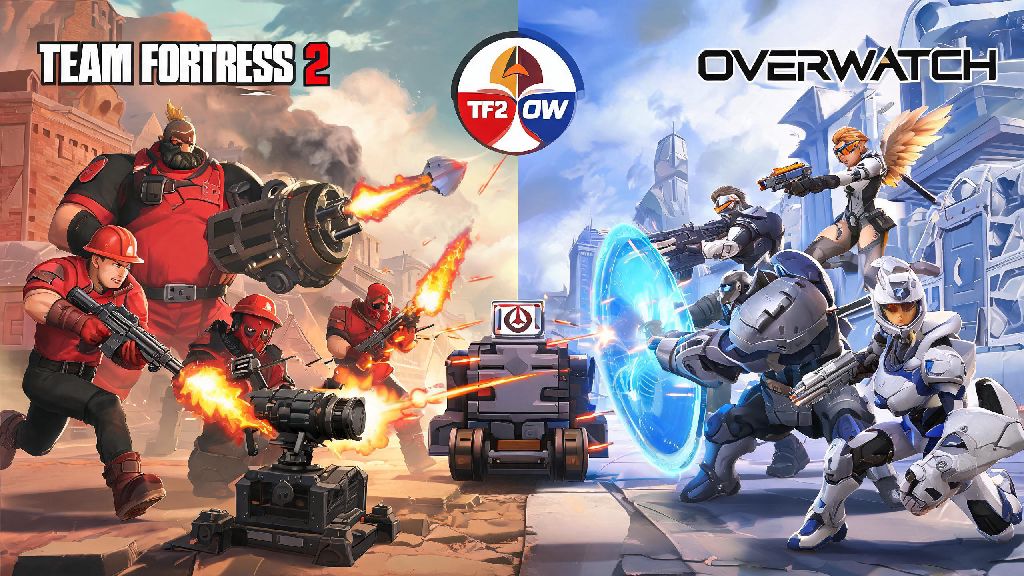
If you’ve spent any time browsing hero shooter communities, you’ve almost certainly stumbled on the question: is Team Fortress 2 like Overwatch? Both helped define the team-based shooter genre, but they’ve evolved in wildly different directions in the years since their respective launches. I’ve put 2000+ hours into both games across casual lobbies and competitive leagues, so I’m breaking down exactly where they overlap, where they diverge, and who each game is best for.
Core Gameplay: Is Team Fortress 2 Like Overwatch At Its Base?
If you’ve only played one of the two, you might assume the answer to is Team Fortress 2 like Overwatch is a simple yes, but that’s not the full story. Both games are built around team-based objective play, with shared core objective types like payload pushes, control point captures, and attack/defend map layouts. That’s where the surface-level similarities end, though.
Both games share core objective-focused team play at their core, but TF2 uses 12v12 lobbies for most casual play, while Overwatch is built entirely around 5v5 matches. The larger lobby size in TF2 creates far more chaotic, less structured matches where individual play has less impact on the overall outcome. Overwatch’s smaller teams mean every player’s performance matters, even in casual quick play lobbies.
TF2’s larger lobbies are designed for chaotic, low-stakes fun even if you’re not playing optimally. You can mess around with off-meta weapon loadouts, chase enemy spies across the map, or even just sit in the spawn room trading cosmetics with teammates, and no one will bat an eye. That level of freedom doesn’t exist in Overwatch, where even casual matches expect you to contribute to the objective to avoid being reported by teammates.
Class and Hero Design Differences You’ll Notice Immediately
The biggest difference that answers if is Team Fortress 2 like Overwatch is how their class systems are built. TF2 has nine fixed classes that haven’t changed in their core identity since the game launched in 2007. Each class has a default weapon loadout, plus dozens of unlockable weapons that alter their playstyle without changing their core role. A heavy will always be a high-health frontline fighter, but you can build him to be a slow defensive anchor, a fast close-range brawler, or even a support focused on buffing teammates with ammo packs.
Overwatch uses a hero system with over 35 unique characters, each with a fixed, unchangeable kit of abilities and an ultimate ability that charges as you deal damage and heal allies. New heroes are added every few months, and existing heroes get regular balance changes that can completely shift how they’re played. TF2’s class system prioritizes player choice over character-specific identity, while Overwatch prioritizes unique character identity and counterplay above all else.
Overwatch’s hero roster is designed to counter specific picks, forcing regular team composition shifts mid-match. If the enemy team picks a tough tank like Reinhardt, you’re expected to switch to a damage hero that can break his shield, like Reaper or Junkrat. That level of forced counterplay doesn’t exist in TF2, where you can stick to one class for an entire match regardless of what the enemy team picks, as long as you’re skilled enough to make it work.
Casual and Competitive Play Experiences
Many new players ask is Team Fortress 2 like Overwatch when they’re looking for a new competitive shooter, and the short answer is not when it comes to ranked play. Overwatch has a fully supported official ranked mode, with tiered ranks from Bronze to Grandmaster, strict skill-based matchmaking, and regular seasonal resets. It also had a professional esports league for years, with official support from Blizzard, and competitive play is a core part of the game’s identity.
TF2 has almost no official competitive support, so its competitive community is entirely driven by passionate fans. The game has an official ranked mode, but it’s barely updated, has a tiny player base, and most serious competitive play happens on community-run servers with custom rules. Most TF2 players don’t touch competitive play at all, sticking to casual lobbies or custom community game modes.
Overwatch’s casual play also has far more structure than TF2’s. Overwatch’s ranked mode uses strict skill-based matchmaking to pair you with players of similar skill level, and most modes use a 2-2-2 role lock that requires teams to have two tanks, two damage heroes, and two supports. TF2 has no role lock at all in casual play, so you can have an entire team of snipers or spies if everyone feels like messing around. I’ve had whole matches in TF2 where the entire server stopped pushing the objective to have a dance party in the middle of the map, something you’d never see in even the most casual Overwatch lobby.
Community and Long-Term Play Value
Community support is another big factor when answering if is Team Fortress 2 like Overwatch. TF2 has one of the most dedicated modding communities in gaming, with thousands of custom maps, game modes, and even total conversions created by fans over the last 16 years. You can play everything from custom zombie survival modes to full-fledged roleplay servers, all for free, and the community is still releasing new content every week.
TF2’s modding community has created thousands of custom maps, modes, and even total conversions that keep the game fresh 16+ years after launch. Overwatch, by comparison, has almost no modding support, so all new content has to be released officially by Blizzard. The game gets seasonal updates every few months with new heroes, maps, and cosmetic items, but there’s no way for fans to create their own content to fill in gaps between official updates.
Both games are free to play now, but their monetization systems are very different. TF2 has a player-run trading economy where you can buy, sell, and trade cosmetic items and weapons with other players, with no artificial time gates. Overwatch uses a battle pass system, where you have to play for dozens of hours each season to unlock new cosmetics, or pay extra to get them immediately. If you hate battle passes and FOMO-driven monetization, TF2’s system is far more user-friendly.
At the end of the day, the question is Team Fortress 2 like Overwatch has a complicated answer: they share core hero shooter DNA, but their design priorities, community, and day-to-day play experiences are almost entirely different. If you want structured, competitive play with regular new hero drops and a polished official ranked system, Overwatch is probably the better pick for you. If you want chaotic, low-stakes fun with endless custom content and no pressure to keep up with constant meta shifts, TF2 is the clear choice. Both are foundational to the team shooter genre, and it’s worth giving both a shot to see which fits your playstyle best.