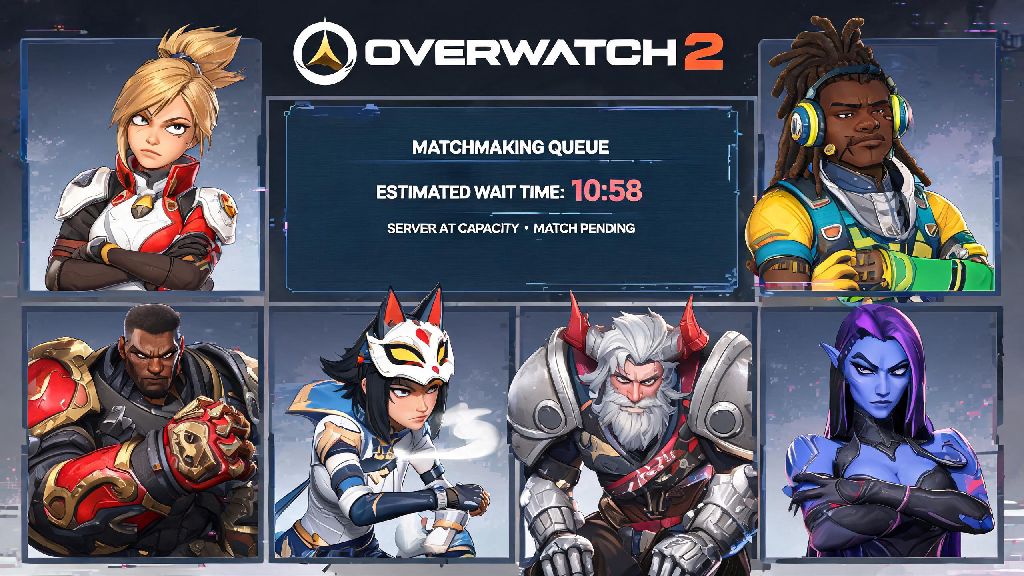
If you’ve sat staring at a loading screen counting down estimated wait times instead of popping off as Tracer or holding the line as Reinhardt, you’ve probably wondered why is there a queue for Overwatch 2 far longer than the 2-3 minutes the game initially quotes. I’ve lost count of the nights I planned a quick competitive match with friends, only to end up waiting 15+ minutes for a lobby to fill, or getting kicked back to the queue after a failed connection. I’ve even had times where the queue timer reset entirely after 10 minutes of waiting, forcing me to start all over again. This guide breaks down the most common reasons for those frustrating waits, plus small tweaks you can make to cut down your time stuck waiting to play.
Core reasons why is there a queue for Overwatch 2
The most frequent causes of long queues tie back to server capacity and matchmaking rules, not issues with your internet or account. Peak play hours between 7PM and 11PM local time are the most common culprit for extended queues, especially on weekends when casual players log on en masse. I remember when Kiriko first launched, I waited 22 minutes to get into a quick play match, because every player in my region was logging on to try the new hero at the same time. Big content drops like new heroes, map releases, or season launches draw millions of extra players, so Blizzard’s servers intentionally throttle connection speeds to avoid total crashes.
Role queue imbalance is the second biggest cause – far more players queue for damage roles than tank or support, so damage players can wait 3x longer than support players in most ranks. For competitive play, the game also has strict matchmaking rules to keep matches fair: it tries to pair you with players of nearly identical SR, similar ping, and matching role selections. If you’re a high-elo damage player in a less populated region, there might only be a few dozen other players matching your criteria online at any given time, so you’ll wait much longer for a lobby to fill.
How account status impacts your queue wait time
If you’re facing longer waits than your friends who play the same rank and role, your account status might be the cause. The most common account-related issue is low priority queue, a penalty applied to players who leave matches early, go AFK mid-game, or get repeated reports for toxic behavior. Low priority queue adds a mandatory extra wait time to every match you queue for, and it applies for a set number of games before it lifts. Low priority queue penalties can stack if you leave multiple matches in a short window, so even one mid-match exit can add extra wait time for your next 5 games.
New accounts also face longer queues as the game calibrates your hidden MMR. For the first 20-30 matches you play, Overwatch 2 doesn’t have enough data to accurately place you against similarly skilled players, so it takes longer to find balanced lobbies. New accounts also have to complete a set of introductory challenges before they can access competitive mode, and trying to queue for competitive before you meet those requirements can leave you stuck in an endless loading loop.
Wondering if you’re stuck in low priority queue? Look for these common signs:
Simple tweaks to cut down your Overwatch 2 queue time
Most long queues can be shortened with small adjustments to your settings or playstyle, no technical fixes required. Flexing to support or tank is the single fastest way to reduce your queue time, especially in gold to platinum ranks where role imbalance is the most severe. I used to only queue as damage and wait 8-12 minutes per match, but once I started queuing as either damage or support, my average wait time dropped to under 2 minutes. If you’re playing with a group, make sure you have a mix of roles selected: a group with one tank, one support, and one damage will find lobbies far faster than three players all queuing as damage.
Another easy fix is to double check your region and crossplay settings. Make sure you’re queued for your local region instead of a distant one, even if the distant one shows slightly lower ping on paper. Queuing for a region that’s currently in off-peak hours (like queuing for EU servers at 2AM ET) will drastically reduce the player pool and extend your wait time. If you’re willing to enable crossplay, you’ll also have access to a much larger pool of players across console and PC, which cuts down wait times for most ranks.
If you don’t want to flex roles or change your settings, try queuing during off-peak hours. Early afternoons on weekdays or late nights after 1AM local time have far fewer players online, so the role imbalance is less severe. You can also stick to quick play instead of competitive if you’re in a hurry: quick play has looser matchmaking rules, so it can put together lobbies much faster even if there’s a role shortage.
When long queues mean a larger server issue
Sometimes long queues have nothing to do with your settings or account, and are instead caused by server-side problems. If your queue time is over 20 minutes with no progress, it’s almost always a server-side issue instead of a problem with your account or settings. Scheduled maintenance is the most common server-related cause: when Blizzard is rolling out a new patch or updating servers, it gradually winds down existing lobbies, so players who queue during the maintenance window will face extended waits or failed connections.
Rarely, DDoS attacks or unexpected server outages can cause massive queue times across all regions. If all of your friends are facing the same long wait times, or you see posts about server issues on official Overwatch social channels, there’s nothing you can do on your end to fix the problem. Restarting your game or resetting your internet won’t speed up the queue, so you’re better off taking a break and waiting for Blizzard to post an update about when the issue will be resolved. Most unexpected server outages are fixed within 1-2 hours, so you won’t have to wait long to jump back into games.
At the end of the day, most of the frustration around why is there a queue for Overwatch 2 comes down to simple fixes you can control, or temporary server issues that resolve themselves in a few hours. If you’re tired of waiting, try flexing to a different role, checking your account for low priority penalties, or queuing during off-peak hours to jump into matches faster. You don’t have to waste half your play session staring at a loading screen if you know what to look for, and small adjustments can make a huge difference in how much time you spend playing instead of waiting.